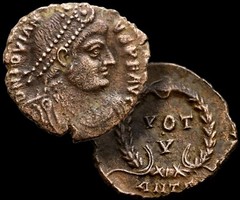


Constans Gay Emperor Constantine the Great son with labarum Roman Coin i35509
Specifications
| Return Shipping Will Be Paid By | Seller |
| All Returns Accepted | Returns Accepted |
| Item Must Be Returned Within | 30 Days |
| Refund Will Be Given As | Money Back |
| Year | Year_in_description |
Item: i35509 Authentic Ancient Coin of: Constans - Roman Emperor: 337-350 A.D. - Son of Constantine I the Great Bronze AE Centenionalis 20mm (4.32 grams) Alexandria mint: 347-348 A.D. Reference: RIC VIII 57 DN CONSTANS PF AVG, diademed bust left with globe FEL TEMP REPARATIO, emperor standing left, holding labarum and shield, two captives, kneeling and leaning left before him, ALEГ in ex. You are bidding on the exact item pictured, provided with a Certificate of Authenticity and Lifetime Guarantee of Authenticity. Labarum of Constantine I, displaying the "Chi-Rho" symbol above. The labarum was a vexillum (military standard) that displayed the "Chi-Rho" symbol ☧, formed from the first two Greek letters of the word "Christ" - Chi and Rho. It was first used by the Roman emperor Constantine I. Since the vexillum consisted of a flag suspended from the crossbar of a cross, it was ideally suited to symbolize the crucifixion of Christ. Later usage has sometimes regarded the terms "labarum" and "Chi-Rho" as synonyms. Ancient sources, however, draw an unambiguous distinction between the two. Etymology Beyond its derivation from Latin labarum, the etymology of the word is unclear. Some derive it from Latin /labāre/ 'to totter, to waver' (in the sense of the "waving" of a flag in the breeze) or laureum [vexillum] ("laurel standard"). According to the Real Academia Española, the related lábaro is also derived from Latin labărum but offers no further derivation from within Latin, as does the Oxford English Dictionary.[5] An origin as a loan into Latin from a Celtic language or Basque has also been postulated. There is a traditional Basque symbol called the lauburu; though the name is only attested from the 19th century onwards the motif occurs in engravings dating as early as the 2nd century AD. Vision of Constantine A coin of Constantine (c.337) showing a depiction of his labarum spearing a serpent. On the evening of October 27, 312, with his army preparing for the Battle of the Milvian Bridge, the emperor Constantine I claimed to have had a vision which led him to believe he was fighting under the protection of the Christian God. Lactantius states that, in the night before the battle, Constantine was commanded in a dream to "delineate the heavenly sign on the shields of his soldiers". He obeyed and marked the shields with a sign "denoting Christ". Lactantius describes that sign as a "staurogram", or a Latin cross with its upper end rounded in a P-like fashion, rather than the better known Chi-Rho sign described by Eusebius of Caesarea. Thus, it had both the form of a cross and the monogram of Christ's name from the formed letters "X" and "P", the first letters of Christ's name in Greek. From Eusebius, two accounts of a battle survive. The first, shorter one in the Ecclesiastical History leaves no doubt that God helped Constantine but doesn't mention any vision. In his later Life of Constantine, Eusebius gives a detailed account of a vision and stresses that he had heard the story from the emperor himself. According to this version, Constantine with his army was marching somewhere (Eusebius doesn't specify the actual location of the event, but it clearly isn't in the camp at Rome) when he looked up to the sun and saw a cross of light above it, and with it the Greek words Ἐν Τούτῳ Νίκα. The traditionally employed Latin translation of the Greek is in hoc signo vinces- literally "In this sign, you will conquer." However, a direct translation from the original Greek text of Eusebius into English gives the phrase "By this, conquer!" At first he was unsure of the meaning of the apparition, but the following night he had a dream in which Christ explained to him that he should use the sign against his enemies. Eusebius then continues to describe the labarum, the military standard used by Constantine in his later wars against Licinius, showing the Chi-Rho sign. Those two accounts can hardly be reconciled with each other, though they have been merged in popular notion into Constantine seeing the Chi-Rho sign on the evening before the battle. Both authors agree that the sign was not readily understandable as denoting Christ, which corresponds with the fact that there is no certain evidence of the use of the letters chi and rho as a Christian sign before Constantine. Its first appearance is on a Constantinian silver coin from c. 317, which proves that Constantine did use the sign at that time, though not very prominently. He made extensive use of the Chi-Rho and the labarum only later in the conflict with Licinius. The vision has been interpreted in a solar context (e.g. as a solar halo phenomenon), which would have been reshaped to fit with the Christian beliefs of the later Constantine. An alternate explanation of the intersecting celestial symbol has been advanced by George Latura, which claims that Plato's visible god in Timaeus is in fact the intersection of the Milky Way and the Zodiacal Light, a rare apparition important to pagan beliefs that Christian bishops reinvented as a Christian symbol. Eusebius' description of the labarum "A Description of the Standard of the Cross, which the Romans now call the Labarum." "Now it was made in the following manner. A long spear, overlaid with gold, formed the figure of the cross by means of a transverse bar laid over it. On the top of the whole was fixed a wreath of gold and precious stones; and within this, the symbol of the Saviour's name, two letters indicating the name of Christ by means of its initial characters, the letter P being intersected by X in its centre: and these letters the emperor was in the habit of wearing on his helmet at a later period. From the cross-bar of the spear was suspended a cloth, a royal piece, covered with a profuse embroidery of most brilliant precious stones; and which, being also richly interlaced with gold, presented an indescribable degree of beauty to the beholder. This banner was of a square form, and the upright staff, whose lower section was of great length, of the pious emperor and his children on its upper part, beneath the trophy of the cross, and immediately above the embroidered banner." "The emperor constantly made use of this sign of salvation as a safeguard against every adverse and hostile power, and commanded that others similar to it should be carried at the head of all his armies." Iconographic career under Constantine Coin of Vetranio, a soldier is holding two labara. Interestingly they differ from the labarum of Constantine in having the Chi-Rho depicted on the cloth rather than above it, and in having their staves decorated with phalerae as were earlier Roman military unit standards. The emperor Honorius holding a variant of the labarum - the Latin phrase on the cloth means "In the name of Christ [rendered by the Greek letters XPI] be ever victorious." Among a number of standards depicted on the Arch of Constantine, which was erected, largely with fragments from older monuments, just three years after the battle, the labarum does not appear. A grand opportunity for just the kind of political propaganda that the Arch otherwise was expressly built to present was missed. That is if Eusebius' oath-confirmed account of Constantine's sudden, vision-induced, conversion can be trusted. Many historians have argued that in the early years after the battle the emperor had not yet decided to give clear public support to Christianity, whether from a lack of personal faith or because of fear of religious friction. The arch's inscription does say that the Emperor had saved the res publica INSTINCTV DIVINITATIS MENTIS MAGNITVDINE ("by greatness of mind and by instinct [or impulse] of divinity"). As with his predecessors, sun symbolism - interpreted as representing Sol Invictus (the Unconquered Sun) or Helios, Apollo or Mithras - is inscribed on his coinage, but in 325 and thereafter the coinage ceases to be explicitly pagan, and Sol Invictus disappears. In his Historia Ecclesiae Eusebius further reports that, after his victorious entry into Rome, Constantine had a statue of himself erected, "holding the sign of the Savior [the cross] in his right hand." There are no other reports to confirm such a monument. Whether Constantine was the first Christian emperor supporting a peaceful transition to Christianity during his rule, or an undecided pagan believer until middle age, strongly influenced in his political-religious decisions by his Christian mother St. Helena, is still in dispute among historians. As for the labarum itself, there is little evidence for its use before 317.In the course of Constantine's second war against Licinius in 324, the latter developed a superstitious dread of Constantine's standard. During the attack of Constantine's troops at the Battle of Adrianople the guard of the labarum standard were directed to move it to any part of the field where his soldiers seemed to be faltering. The appearance of this talismanic object appeared to embolden Constantine's troops and dismay those of Licinius.At the final battle of the war, the Battle of Chrysopolis, Licinius, though prominently displaying the images of Rome's pagan pantheon on his own battle line, forbade his troops from actively attacking the labarum, or even looking at it directly.[16] Constantine felt that both Licinius and Arius were agents of Satan, and associated them with the serpent described in the Book of Revelation (12:9). Constantine represented Licinius as a snake on his coins. Eusebius stated that in addition to the singular labarum of Constantine, other similar standards (labara) were issued to the Roman army. This is confirmed by the two labara depicted being held by a soldier on a coin of Vetranio (illustrated) dating from 350. Later usage Modern ecclesiastical labara (Southern Germany). The emperor Constantine Monomachos (centre panel of a Byzantine enamelled crown) holding a miniature labarum Constans (Latin: Flavius Julius Constans Augustus) (c.323-350) was Roman Emperor from 337 to 350. He defeated his brother Constantine II in 340, but anger in the army over his personal life and preference for his barbarian bodyguards led the general Magnentius to rebel, resulting in the assassination of Constans in 350. Career Constans was the third and youngest son of Constantine the Great and Fausta, his father's second wife. He was educated at the court of his father at Constantinople under the tutelage of the poet Aemilius Magnus Arborius. On 25 December 333, Constantine I elevated Constans to the rank of Caesar at Constantinople. Constans became engaged to Olympias, the daughter of the Praetorian Prefect Ablabius, but the marriage never came to pass.With Constantine's death in 337, Constans and his two brothers, Constantine II and Constantius II, divided the Roman world between themselves and disposed of virtually all relatives who could possibly have a claim to the throne.The army proclaimed them Augusti on September 9, 337. Almost immediately, Constans was required to deal with a Sarmatian invasion in late 337, over whom he won a resounding victory. Division of the Roman Empire among the Caesars appointed by Constantine I: from left to right, the territories of Constantine II, Constans, Dalmatius and Constantius II. After the death of Constantine I (May 337), this was the formal division of the Empire, until Dalmatius was killed and his territory divided between Constans and Constantius. Constans was initially under the guardianship of Constantine II. The original settlement assigned Constans the praetorian prefectures of Italy and Africa.[6] Constans was unhappy with this division, so the brothers met at Viminacium in 338 to revise the boundaries.[6] Constans managed to extract the prefecture of Illyricum and the diocese of Thrace,[6] provinces that were originally to be ruled by his cousin Dalmatius, as per Constantine I's proposed division after his death.[5] Constantine II soon complained that he had not received the amount of territory that was his due as the eldest son.[7] Annoyed that Constans had received Thrace and Macedonia after the death of Dalmatius, Constantine demanded that Constans hand over the African provinces, which he agreed to do in order to maintain a fragile peace.[7][8] Soon, however, they began quarreling over which parts of the African provinces belonged to Carthage, and thus Constantine, and which belonged to Italy, and therefore Constans.[9] This led to growing tensions between the two brothers, which were only heightened by Constans finally coming of age and Constantine refusing to give up his guardianship. In 340 Constantine II invaded Italy.[8] Constans, at that time in Dacia, detached and sent a select and disciplined body of his Illyrian troops, stating that he would follow them in person with the remainder of his forces.[7] Constantine was eventually trapped at Aquileia, where he died, leaving Constans to inherit all of his brother's former territories - Hispania, Britannia and Gaul.[4] Constans began his reign in an energetic fashion.[4] In 341-42, he led a successful campaign against the Franks, and in the early months of 343 he visited Britain.[3] The source for this visit, Julius Firmicus Maternus, does not provide a reason, but the quick movement and the danger involved in crossing the channel in the dangerous winter months suggests it was in response to a military emergency, possibly to repel the Picts and Scots.[3] Regarding religion, Constans was tolerant of Judaism but promulgated an edict banning pagan sacrifices in 341.[3] He suppressed Donatism in Africa and supported Nicene orthodoxy against Arianism, which was championed by his brother Constantius. Although Constans called the Council of Sardica in 343 to settle the conflict,[10] it was a complete failure,[11] and by 346 the two emperors were on the point of open warfare over the dispute.[12] The conflict was only resolved by an interim agreement which allowed each emperor to support their preferred clergy within their own spheres of influence.[12] Death In the final years of his reign, Constans developed a reputation for cruelty and misrule. Dominated by favourites and openly preferring his select bodyguard, he lost the support of the legions who were also offended by his homosexuality. In 350, the general Magnentius declared himself emperor at Augustodunum with the support of the troops on the Rhine frontier, and later the western provinces of the Empire. Constans was enjoying himself nearby when he was notified of the elevation of Magnentius. Lacking any support beyond his immediate household, he was forced to flee for his life. As he was trying to reach either Italy or Spain, supporters of Magnentius cornered him in a fortification in Vicus Helena (now Elne) in the Pyrenees, southwestern Gaul, where he was killed after seeking sanctuary in a temple. In Roman mythology, Victoria was the personification/Goddess of victory. She is the Roman version of the Greek goddess Nike, and was associated with Bellona. She was adapted from the Sabine agricultural goddess Vacuna and had a temple on the Palatine Hill. Her name (in Latin) means victory. Unlike the Greek Nike, Victoria (Latin for "victory") was a major part of Roman society. Multiple temples were erected in her honour. When her statue was removed in 382 AD by emperor Gratianus there was much anger in Rome. She was normally worshipped by triumphant generals returning from war. Also unlike the Greek Nike, who was known for success in athletic games such as chariot races, Victoria was a symbol of victory over death and determined who would be successful during war. Appearing on Roman coins, jewelry, architecture, and other arts, Victoria is often seen with or in a chariot. An example of this is her place upon the Brandenburg Gate in Berlin, Germany. In Greek mythology, Nike was a goddess who personified victory, also known as the Winged Goddess of Victory. The Roman equivalent was Victoria. Depending upon the time of various myths, she was described as the daughter of Pallas (Titan) and Styx (Water) and the sister of Kratos (Strength), Bia (Force), and Zelus (Zeal). Nike and her siblings were close companions of Zeus, the dominant deity of the Greek pantheon. According to classical (later) myth, Styx brought them to Zeus when the god was assembling allies for the Titan War against the older deities. Nike assumed the role of the divine charioteer, a role in which she often is portrayed in Classical Greek art. Nike flew around battlefields rewarding the victors with glory and fame. Nike is seen with wings in most statues and paintings. Most other winged deities in the Greek pantheon had shed their wings by Classical times. Nike is the goddess of strength, speed, and victory. Nike was a very close acquaintance of Athena, and is thought to have stood in Athena's outstretched hand in the statue of Athena located in the Parthenon. Nike is one of the most commonly portrayed figures on Greek coins. Names stemming from Nike include amongst others: Nicholas, Nicola, Nick, Nikolai, Nils, Klaas, Nicole, Ike, Niki, Nikita, Nika, Niketas, and Nico. The Roman Empire (Latin: Imperium Romanum) was the post-Republican period of the ancient Roman civilization, characterised by an autocratic form of government and large territorial holdings in Europe and around the Mediterranean. The Roman Empire at its greatest extent, during the reign of Trajan in 117 AD The 500-year-old Roman Republic, which preceded it, had been weakened and subverted through several civil wars. Several events are commonly proposed to mark the transition from Republic to Empire, including Julius Caesar's appointment as perpetual dictator (44 BC), the Battle of Actium (2 September 31 BC), and the Roman Senate's granting to Octavian the honorific Augustus (16 January 27 BC). Roman expansion began in the days of the Republic, but the Empire reached its greatest extent under Emperor Trajan: during his reign (98 to 117 AD) the Roman Empire controlled approximately 6.5 million km2 of land surface. Because of the Empire's vast extent and long endurance, the institutions and culture of Rome had a profound and lasting influence on the development of language, religion, architecture, philosophy, law, and forms of government in the territory it governed, particularly Europe, and by means of European expansionism throughout the modern world. In the late 3rd century AD, Diocletian established the practice of dividing authority between four co-emperors (known as the tetrarchy) in order to better secure the vast territory, putting an end to the Crisis of the Third Century. During the following decades the Empire was often divided along an East/West axis. After the death of Theodosius I in 395 it was divided for the last time. The Western Roman Empire collapsed in 476 as Romulus Augustus was forced to abdicate to the Germanic warlord Odoacer. The Eastern Roman or Byzantine Empire ended in 1453 with the death of Constantine XI and the capture of Constantinople to Mehmed II, leader of the Ottoman Turks. Government Emperor The powers of an emperor (his imperium) existed, in theory at least, by virtue of his "tribunician powers" (potestas tribunicia) and his "proconsular powers" (imperium proconsulare). In theory, the tribunician powers (which were similar to those of the Plebeian Tribunes under the old republic) made the Emperor's person and office sacrosanct, and gave the Emperor authority over Rome's civil government, including the power to preside over and to control the Senate. The proconsular powers (similar to those of military governors, or Proconsuls, under the old Republic) gave him authority over the Roman army. He was also given powers that, under the Republic, had been reserved for the Senate and the assemblies, including the right to declare war, to ratify treaties, and to negotiate with foreign leaders. The emperor also had the authority to carry out a range of duties that had been performed by the censors, including the power to control Senate membership. In addition, the emperor controlled the religious institutions, since, as emperor, he was always Pontifex Maximus and a member of each of the four major priesthoods. While these distinctions were clearly defined during the early Empire, eventually they were lost, and the emperor's powers became less constitutional and more monarchical. Realistically, the main support of an emperor's power and authority was the military. Being paid by the imperial treasury, the legionaries also swore an annual military oath of loyalty towards him, called the Sacramentum. The death of an emperor led to a crucial period of uncertainty and crisis. In theory the Senate was entitled to choose the new emperor, but most emperors chose their own successors, usually a close family member. The new emperor had to seek a swift acknowledgement of his new status and authority in order to stabilize the political landscape. No emperor could hope to survive, much less to reign, without the allegiance and loyalty of the Praetorian Guard and of the legions. To secure their loyalty, several emperors paid the donativum, a monetary reward. Senate While the Roman assemblies continued to meet after the founding of the Empire, their powers were all transferred to the Roman Senate, and so senatorial decrees (senatus consulta) acquired the full force of law. In theory, the Emperor and the Senate were two equal branches of government, but the actual authority of the Senate was negligible and it was largely a vehicle through which the Emperor disguised his autocratic powers under a cloak of republicanism. Although the Senate still commanded much prestige and respect, it was largely a glorified rubber stamp institution. Stripped of most of its powers, the Senate was largely at the Emperor's mercy. Many emperors showed a certain degree of respect towards this ancient institution, while others were notorious for ridiculing it. During Senate meetings, the Emperor sat between the two consuls,[18] and usually acted as the presiding officer. Higher ranking senators spoke before lower ranking senators, although the Emperor could speak at any time.[18] By the 3rd century, the Senate had been reduced to a glorified municipal body. Senators and equestrians No emperor could rule the Empire without the Senatorial order and the Equestrian order. Most of the more important posts and offices of the government were reserved for the members of these two aristocratic orders. It was from among their ranks that the provincial governors, legion commanders, and similar officials were chosen. These two classes were hereditary[citation needed] and mostly closed to outsiders. Very successful and favoured individuals could enter, but this was a rare occurrence. The career of a young aristocrat was influenced by his family connections and the favour of patrons. As important as ability, knowledge, skill, or competence, patronage was considered vital for a successful career and the highest posts and offices required the Emperor's favour and trust. Senatorial order The son of a senator was expected to follow the Cursus honorum, a career ladder, and the more prestigious positions were restricted to senators only. A senator also had to be wealthy; one of the basic requirements was the wealth of 12,000 gold aurei (about 100 kg of gold), a figure which would later be raised with the passing of centuries. Equestrian order Below the Senatorial order was the Equestrian order. The requirements and posts reserved for this class, while perhaps not so prestigious, were still very important. Some of the more vital posts, like the governorship of Egypt (Latin Aegyptus), were even forbidden to the members of the Senatorial order and available only to equestrians. Military Legions During and after the civil war, Octavian reduced the huge number of the legions (over 60) to a much more manageable and affordable size (28). Several legions, particularly those with doubtful loyalties, were simply disbanded. Other legions were amalgamated, a fact suggested by the title Gemina (Twin). In AD 9, Germanic tribes wiped out three full legions in the Battle of the Teutoburg Forest. This disastrous event reduced the number of the legions to 25. The total of the legions would later be increased again and for the next 300 years always be a little above or below 30. Augustus also created the Praetorian Guard: nine cohorts ostensibly to maintain the public peace which were garrisoned in Italy. Better paid than the legionaries, the Praetorians also served less time; instead of serving the standard 25 years of the legionaries, they retired after 16 years of service. Auxilia While the auxilia (Latin: auxilia=supports) are not as famous as the legionaries, they were of major importance. Unlike the legionaries, the auxilia were recruited from among the non-citizens. Organized in smaller units of roughly cohort strength, they were paid less than the legionaries, and after 25 years of service were rewarded with Roman citizenship, also extended to their sons. According to Tacitus there were roughly as many auxiliaries as there were legionaries. Since at this time there were 25 legions of around 5,000 men each, the auxilia thus amounted to around 125,000 men, implying approximately 250 auxiliary regiments. Navy The Roman navy (Latin: Classis, lit. "fleet") not only aided in the supply and transport of the legions, but also helped in the protection of the frontiers in the rivers Rhine and Danube. Another of its duties was the protection of the very important maritime trade routes against the threat of pirates. Therefore it patrolled the whole of the Mediterranean, parts of the North Atlantic (coasts of Hispania, Gaul, and Britannia), and had also a naval presence in the Black Sea. Nevertheless the army was considered the senior and more prestigious branch. Provinces The Temple of Bacchus in Baalbec, Lebanon Until the Tetrarchy (296 AD) Roman provinces (lat. provincae) were administrative and territorial units of the Roman Empire outside of Italy. In the old days of the Republic the governorships of the provinces were traditionally awarded to members of the Senatorial Order. Augustus' reforms changed this policy. Imperial provinces Augustus created the Imperial provinces. Most, but not all, of the Imperial provinces were relatively recent conquests and located at the borders. Thereby the overwhelming majority of legions, which were stationed at the frontiers, were under direct Imperial control. Very important was the Imperial province of Egypt, the major breadbasket of the Empire, whose grain supply was vital to feed the masses in Rome. It was considered the personal fiefdom of the Emperor, and Senators were forbidden to even visit this province. The governor of Egypt and the commanders of any legion stationed there were not from the Senatorial Order, but were chosen by the Emperor from among the members of the lower Equestrian Order. Senatorial provinces The old traditional policy continued largely unchanged in the Senatorial provinces. Due to their location, away from the borders, and to the fact that they were under longer Roman sovereignty and control, these provinces were largely peaceful and stable. Only a single legion was based in a Senatorial province: Legio III Augusta, stationed in the Senatorial province of Africa (modern northern Algeria). The status of a province was subject to change; it could change from Senatorial towards Imperial, or vice-versa. This happened several times [26] during Augustus' reign. Another trend was to create new provinces, mostly by dividing older ones, or by expanding the Empire. Religion The Pantheon, the present structure built during Hadrian's reign, was dedicated to the worship of all Roman deities. As the Empire expanded, and came to include people from a variety of cultures, the worship of an ever increasing number of deities was tolerated and accepted. The Imperial government, and the Romans in general, tended to be very tolerant towards most religions and cults, so long as they did not cause trouble. This could easily be accepted by other faiths as Roman liturgy and ceremonies were frequently tailored to fit local culture and identity. Since the Romans practiced polytheism they were also able to easily assimilate the gods of the peoples the Empire conquered. An individual could attend to both the Roman gods representing his Roman identity and his own personal faith, which was considered part of his personal identity. There were periodic persecutions of various religions at various points in time, most notably that of Christians. As the historian Edward Gibbon noted, however, most of the recorded histories of Christian persecutions come to us through the Christian church, which had an incentive to exaggerate the degree to which the persecutions occurred. The non-Christian contemporary sources only mention the persecutions passingly and without assigning great importance to them. Imperial cult The Augustus of Prima Porta, showing Augustus in military outfit holding a consular baton (now broken off) In an effort to enhance loyalty, the inhabitants of the Empire were called to participate in the Imperial cult to revere (usually deceased) emperors as demigods. Few emperors claimed to be Gods while living, with the few exceptions being emperors who were widely regarded at the time to be insane (such as Caligula). Doing so in the early Empire would have risked revealing the shallowness of what the Emperor Augustus called the "restored Republic" and would have had a decidedly eastern quality to it. Since the tool was mostly one the Emperor used to control his subjects, its usefulness would have been greatest in the chaotic later Empire, when the emperors were often Christians and unwilling to participate in the practice. Usually, an emperor was deified after his death by his successor in an attempt by that successor to enhance his own prestige. This practice can be misunderstood, however, since "deification" was to the ancient world what canonization is to the Christian world. Likewise, the term "god" had a different context in the ancient world. This could be seen during the years of the Roman Republic with religio-political practices such as the disbanding of a Senate session if it was believed the gods disapproved of the session or wished a particular vote. Deification was one of the many honors a dead emperor was entitled to, as the Romans (more than modern societies) placed great prestige on honors and national recognitions. The importance of the Imperial cult slowly grew, reaching its peak during the Crisis of the Third Century. Especially in the eastern half of the Empire, imperial cults grew very popular. As such it was one of the major agents of romanization. The central elements of the cult complex were next to a temple; a theatre or amphitheatre for gladiator displays and other games and a public bath complex. Sometimes the imperial cult was added to the cults of an existing temple or celebrated in a special hall in the bath complex. The seriousness of this belief is unclear. Some Romans ridiculed the notion that a Roman emperor was to be considered a living god, or would even make fun of the deification of an emperor after his death. Seneca the Younger parodied the notion of apotheosis in his only known satire The Pumpkinification of Claudius, in which the clumsy and ill-spoken Claudius is transformed not into a god, but a pumpkin or gourd. An element of mockery was present even at Claudius's funeral, and Vespasian's purported last words were Væ, puto deus fio, "Oh dear! I think I'm becoming a god!". Absorption of foreign cults Since Roman religion did not have a core belief that excluded other religions, several foreign gods and cults became popular. The worship of Cybele was the earliest, introduced from around 200 BC. Isis and Osiris were introduced from Egypt a century later. Bacchus and Sol Invictus were quite important and Mithras became very popular with the military. Several of these were Mystery cults. In the 1st century BC Julius Caesar granted Jews the freedom to worship in Rome as a reward for their help in Alexandria. Controversial religions Druids Druids were considered as essentially non-Roman: a prescript of Augustus forbade Roman citizens to practice "druidical" rites. Pliny reports that under Tiberius the druids were suppressed-along with diviners and physicians-by a decree of the Senate, and Claudius forbade their rites completely in AD 54. Judaism While Judaism was largely accepted, as long as Jews paid the Jewish Tax after 70 AD, there was anti-Judaism in the pre-Christian Roman Empire and there were several Jewish-Roman wars. The Crisis under Caligula (37-41) has been proposed as the "first open break between Rome and the Jews", even though problems were already evident during the Census of Quirinius in 6 and under Sejanus (before 31). Until the rebellion in Judea in AD 66, Jews were generally protected. To get around Roman laws banning secret societies and to allow their freedom of worship, Julius Caesar declared Synagogues were colleges. Tiberius forbade Judaism in Rome but they quickly returned to their former protected status. Claudius expelled Jews from the city; however, the passage of Suetonius is ambiguous: "Because the Jews at Rome caused continuous disturbances at the instigation of Chrestus he [Claudius] expelled them from the city." Chrestus has been identified as another form of Christus; the disturbances may have been related to the arrival of the first Christians, and that the Roman authorities, failing to distinguish between the Jews and the early Christians, simply decided to expel them all. Historians debate whether or not the Roman government distinguished between Christians and Jews prior to Nerva's modification of the Fiscus Judaicus in 96. From then on, practising Jews paid the tax; Christians did not.[34] Christianity The Christian Martyrs' Last Prayer, by Jean-Léon Gérôme (1883). Roman Colosseum. Christianity emerged in Roman Judea as a Jewish religious sect in the 1st century AD. The religion gradually spread out of Jerusalem, initially establishing major bases in first Antioch, then Alexandria, and over time throughout the Empire as well as beyond. Christianity shares numerous traits with other mystery cults that existed in Rome at the time. Early Christianity placed a strong emphasis on baptism, a ritual which marked the convert as having been inducted into the mysteries of the faith. The focus on a belief in salvation and the afterlife was another major similarity to other mystery cults. The crucial difference between Christianity and other mystery cults was the monotheism of Christianity. Early Christians thus refused to participate in civic cults because of these monotheistic beliefs, leading to their persecution. For the first two centuries of the Christian era, Imperial authorities largely viewed Christianity simply as a Jewish sect rather than a distinct religion. No emperor issued general laws against the faith or its Church, and persecutions, such as they were, were carried out under the authority of local government officials. A surviving letter from Pliny the Younger, governor of Bythinia, to the Emperor Trajan describes his persecution and executions of Christians; Trajan notably responded that Pliny should not seek out Christians nor heed anonymous denunciations, but only punish open Christians who refused to recant. Suetonius mentions in passing that during the reign of Nero "punishment was inflicted on the Christians, a class of men given to a new and mischievous superstition" (superstitionis novae ac maleficae). He gives no reason for the punishment. Tacitus reports that after the Great Fire of Rome in AD 64, some among the population held Nero responsible and that the emperor attempted to deflect blame onto the Christians. One of the earliest persecutions occurred in Gaul at Lyon in 177. Persecution was often local and sporadic, and some Christians welcomed martyrdom as a testament of faith.[39] The Decian persecution (246-251) was a serious threat to the Church, but while it potentially undermined the religious hierarchy in urban centers, ultimately it served to strengthen Christian defiance.[40] Diocletian undertook what was to be the most severe and last major persecution of Christians, lasting from 303 to 311. Christianity had become too widespread to suppress, and in 313, the Edict of Milan made tolerance the official policy. Constantine I (sole ruler 324-337) became the first Christian emperor, and in 380 Theodosius I established Christianity as the official religion. By the 5th century Christian hegemony had rapidly changed the Empire's identity even as the Western provinces collapsed. Those who practiced the traditional polytheistic religions were persecuted, as were Christians regarded as heretics by the authorities in power. Languages The language of Rome before its expansion was Latin, and this became the empire's official language. By the time of the imperial period Latin had developed two registers: the "high" written Classical Latin and the "low" spoken Vulgar Latin. While Classical Latin remained relatively stable, even through the Middle Ages, Vulgar Latin as with any spoken language was fluid and evolving. Vulgar Latin became the lingua franca in the western provinces, later evolving into the modern Romance languages: Italian, French, Portuguese, Spanish, Romanian, etc. Greek and Classical Latin were the languages of literature, scholarship, and education. Although Latin remained the most widely spoken language in the West, through to the fall of Rome and for some centuries afterwards, in the East the Greek language was the literary language and the lingua franca. The Romans generally did not attempt to supplant local languages. They generally left established customs in place and only gradually introduced typical Roman cultural elements including the Latin language.[43] Along with Greek, many other languages of different tribes were used but almost without expression in writing. Greek was already widely spoken in many cities in the east, and as such, the Romans were quite content to retain it as an administrative language there rather than impede bureaucratic efficiency. Hence, two official secretaries served in the Roman Imperial court, one charged with correspondence in Latin and the other with correspondence in Greek for the East.[44] Thus in the Eastern Province, as with all provinces, original languages were retained. Moreover, the process of hellenisation widened its scope during the Roman period, for the Romans perpetuated "Hellenistic" culture,[47][48][nb 4] but with all the trappings of Roman improvements. This further spreading of "Hellenistic" culture (and therefore language) was largely due to the extensive infrastructure (in the form of entertainment, health, and education amenities, and extensive transportation networks, etc.) put in place by the Romans and their tolerance of, and inclusion of, other cultures, a characteristic which set them apart from the xenophobic nature of the Greeks preceding them. Since the Roman annexation of Greece in 146 BC, the Greek language gradually obtained a unique place in the Roman world, owing initially to the large number of Greek slaves in Roman households. In Rome itself Greek became the second language of the educated elite.It became the common language in the early Church (as its major centers in the early Christian period were in the East), and the language of scholarship and the arts. However, due to the presence of other widely spoken languages in the densely populated east, such as Coptic, Syriac, Armenian, Aramaic and Phoenician (which was also extensively spoken in North Africa), Greek never took as strong a hold beyond Asia Minor (some urban enclaves notwithstanding) as Latin eventually did in the west. This is partly evident in the extent to which the derivative languages are spoken today. Like Latin, the language gained a dual nature with the literary language, an Attic Greek variant, existing alongside spoken language, Koine Greek, which evolved into Medieval or Byzantine Greek (Romaic). By the 4th century AD, Greek no longer held such dominance over Latin in the arts and sciences as it had previously, resulting to a great extent from the growth of the western provinces. This was true also of Christian literature, reflected, for example, in the publication in the early 5th century AD of the Vulgate Bible, the first officially accepted Latin Bible. As the Western Empire declined, the number of people who spoke both Greek and Latin declined as well, contributing greatly to the future East-West / Orthodox-Catholic cultural divide in Europe. Important as both languages were, today the descendants of Latin are widely spoken in many parts of the world, while the Greek dialects are limited mostly to Greece, Cyprus, and small enclaves in Turkey and Southern Italy (where the Eastern Empire retained control for several more centuries). To some degree this can be attributed to the fact that the western provinces fell mainly to "Latinised" Christian tribes whereas the eastern provinces fell to Muslim Arabs and Turks for whom Greek held less cultural significance. Culture Life in the Roman Empire revolved around the city of Rome, and its famed seven hills. The city also had several theatres, gymnasia, and many taverns, baths and brothels. Throughout the territory under Rome's control, residential architecture ranged from very modest houses to country villas, and in the capital city of Rome, to the residences on the elegant Palatine Hill, from which the word "palace" is derived. The vast majority of the population lived in the city centre, packed into apartment blocks. Most Roman towns and cities had a forum and temples, as did the city of Rome itself. Aqueducts were built to bring water to urban centres[55] and served as an avenue to import wine and oil from abroad. Landlords generally resided in cities and their estates were left in the care of farm managers. To stimulate a higher labour productivity, many landlords freed a large numbers of slaves. By the time of Augustus, cultured Greek household slaves taught the Roman young (sometimes even the girls). Greek sculptures adorned Hellenistic landscape gardening on the Palatine or in the
Related Items


![[#1174537] Coin, Gallienus, Antoninianus, 260-268, Rome, VF, Billon, RIC:236](https://konaarc.com/images/kHIAAOSwYWpkf25m/1174537-coin-gallienus-antoninianus-240.webp)