

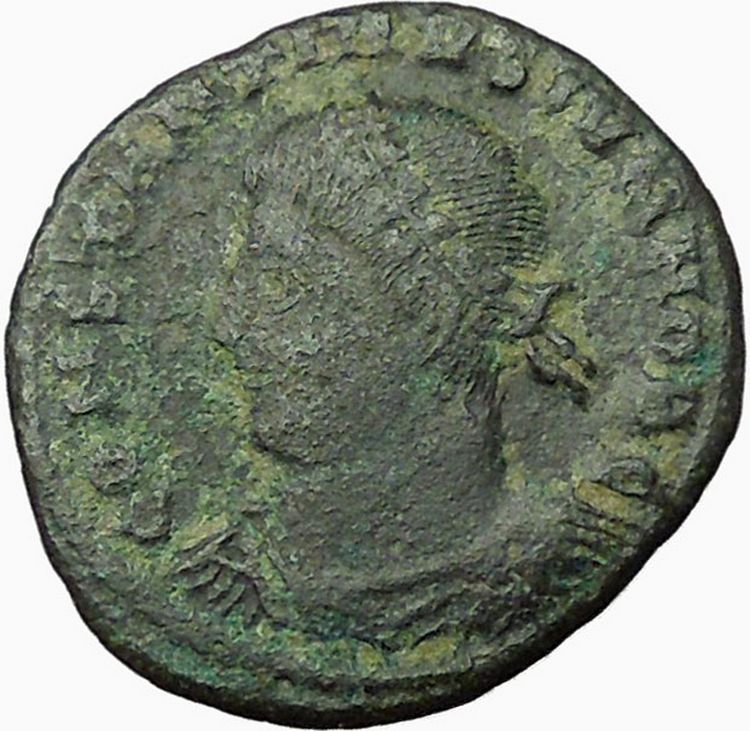


CONSTANTINE II Constantine I son Ancient Roman Coin Military Camp gate i34999
Specifications
| Return Shipping Will Be Paid By | Seller |
| All Returns Accepted | Returns Accepted |
| Item Must Be Returned Within | 30 Days |
| Refund Will Be Given As | Money Back |
| Ruler | Constantine II |
| Ancient Coins | Roman Coins |
| Coin Type | Ancient Roman |
| Year | Year_in_description |
Item: i34999 Authentic Ancient Coin of: Constantine II 'Junior' - Roman Emperor: 337-340 A.D. - Bronze AE3 20mm (2.35 grams) Thessalonica mint circa 337-340 A.D. Reference: RIC 157 (VII, Thessalonica) CONSTANTINVSIVNNOBC - Laureate, draped and cuirassed bust left. PROVIDENTIAECAESS Exe: SMTS - Military Camp gate with two turrets and star above. A military camp or bivouac is a semi-permanent facility for the lodging of an army. Camps are erected when a military force travels away from a major installation or fort during training or operations, and often have the form of large campsites. In the Roman era the military camp had highly stylized parameters and served an entire legion. Archaeological investigations have revealed many details of these Roman camps at sites such as Vindolanda (England) and Raedykes (Scotland). You are bidding on the exact item pictured, provided with a Certificate of Authenticity and Lifetime Guarantee of Authenticity. The Latin word castra , with its singular castrum, was used by the ancient Romans to mean buildings or plots of land reserved to or constructed for use as a military defensive position. The word appears in both Oscan and Umbrian (dialects of Italic) as well as in Latin. In classical Latin the word castra always means "great legionary encampment", both "marching", "temporary" ones and the "fortified permanent" ones, while the diminutive form castellum was used for the smaller forts, which were usually, but not always, occupied by the auxiliary units and used as logistic bases for the legions, as explained by Vegetius.[3] A generic term is praesidium ("guard post or garrison"). The terms stratopedon ("army camp") and phrourion ("fort") were used by Greek language authors, in order to designate the Roman castra and the Roman castellum respectively. In English, the terms "Roman fortress", "Roman fort" and "Roman camp" are commonly used for the castra. However the scholars' convention always requires the use of the word "camp", "marching camp" and "fortress" as a translation of castra and the use of the word "fort" as a translation of castellum and this type of convention is usually followed and found in all the scholarly works. Flavius Claudius Constantinus, known in English as Constantine II, (316-340) was Roman Emperor from 337 to 340. The eldest son of Constantine the Great and Fausta, he was born at Arles, and was raised as a Christian. On March 1, 317, Constantine was made Caesar, and at the age of seven in 323, took part in his father's campaign against the Sarmatians. At the age of ten he became commander of Gaul, after the death of his half-brother Crispus. An inscription dating to 330 records the title of Alamannicus, so it is probable that his generals won a victory over the Alamanni. His military career continued when Constantine I elected his son field commander during the 332 campaign against the Goths. Following the death of his father in 337, Constantine II became emperor jointly with his brothers Constantius II and Constans. After the division of the empire, made by the three brothers in September of the same year in Pannonia, he ruled over Gaul, Britannia and Hispania. He was involved in the struggle between the different Christian streams. The Western portion of the empire leaned towards Catholicism and against Arianism, and Constantine freed Athanasius and allowed him to return to Alexandria. This action also put some burden on Constantius II, who was a supporter of Arianism. At first, he was the guardian of his younger brother Constans, whose portion was Italia, Africa and Illyricum. As Constans came of age, Constantine would not relinquish the guardianship and in 340 he marched against Constans in Italy, but was defeated at Aquileia and he was killed in an ambush in Cervignano del Friuli. Constans came to control his deceased brother's realm. Division of the Roman Empire among the Caesars appointed by Constantine I: from left to right, the territories of Constantine II, Constans I, Dalmatius and Constantius II. After the death of Constantine I (May 337), this was the formal division of the Empire, until Dalmatius was killed and his territory divided between Constans and Constantius. Your browser does not support JavaScript. To view this page, enable JavaScript if it is disabled or upgrade your browser. Frequently Asked Questions How long until my order is shipped?: Depending on the volume of sales, it may take up to 5 business days for shipment of your order after the receipt of payment. How will I know when the order was shipped?: After your order has shipped, you will be left positive feedback, and that date should be used as a basis of estimating an arrival date. After you shipped the order, how long will the mail take? USPS First Class mail takes about 3-5 business days to arrive in the U.S., international shipping times cannot be estimated as they vary from country to country. I am not responsible for any USPS delivery delays, especially for an international package. What is a certificate of authenticity and what guarantees do you give that the item is authentic? Each of the items sold here, is provided with a Certificate of Authenticity, and a Lifetime Guarantee of Authenticity, issued by a world-renowned numismatic and antique expert that has identified over 10000 ancient coins and has provided them with the same guarantee. You will be quite happy with what you get with the COA; a professional presentation of the coin, with all of the relevant information and a picture of the coin you saw in the listing. Compared to other certification companies, the certificate of authenticity is a $25-50 value. So buy a coin today and own a piece of history, guaranteed. Is there a money back guarantee? I offer a 30 day unconditional money back guarantee. I stand behind my coins and would be willing to exchange your order for either store credit towards other coins, or refund, minus shipping expenses, within 30 days from the receipt of your order. My goal is to have the returning customers for a lifetime, and I am so sure in my coins, their authenticity, numismatic value and beauty, I can offer such a guarantee. Is there a number I can call you with questions about my order? You can contact me directly via ask seller a question and request my telephone number, or go to my About Me Page to get my contact information only in regards to items purchased on eBay. When should I leave feedback? Once you receive your order, please leave a positive. Please don't leave any negative feedbacks, as it happens many times that people rush to leave feedback before letting sufficient time for the order to arrive. Also, if you sent an email, make sure to check for my reply in your messages before claiming that you didn't receive a response. The matter of fact is that any issues can be resolved, as reputation is most important to me. My goal is to provide superior products and quality of service. Your browser does not support JavaScript. To view this page, enable JavaScript if it is disabled or upgrade your browser.
Related Items